


AI generated. This is an article about AI.
Five.
That's roughly how many companies are building the most powerful AI systems on the planet right now. Five. Maybe six if you're feeling generous. These systems can write code, diagnose disease, generate music, analyse legal contracts and design buildings. They can pass medical licensing exams and bar exams and probably your performance review.
And they're getting better every few months at a rate that makes Moore's Law look like a gentle stroll.
So here's a number that should sit next to that: 11 million. That's how many people are now actively building on Hugging Face, the open-source platform where anyone can download, modify and deploy AI models. Eleven million developers, researchers, tinkerers and obsessives, working with over two million public models. For free.
Five companies at the top. Eleven million people pulling from below.
That's the tug of war.
We keep asking the wrong question about AI. "Will it take my job?" is the one that dominates headlines and dinner party anxieties, and it's not wrong, exactly. It's just spectacularly unhelpful. Like asking whether electricity would take jobs. The printing press didn't just make books cheaper. It broke the Church's monopoly on knowledge. The internet didn't just give us email. It rewired commerce, politics and the entire concept of a watercooler conversation.
The better questions are structural. Who controls the systems? Who captures the value? And what happens to the rest of us when the intelligence scales but the ownership doesn't?
Because we already know what happens. Every previous technological revolution follows the same pattern: when the technology shifts, power shifts. And AI is doing the same thing in real time.
We can’t tell the future but we can contest it, and the rope has two ends.
THE PULL TOWARDS CONCENTRATION
On one end: centralisation. The gravitational force of capital, compute and control.
Stanford's AI Index shows training costs for frontier models now running into the hundreds of millions of dollars. That creates a moat the size of the Pacific Ocean. The intelligence is global. The ownership is not. A small number of companies own the most powerful systems, and the business of making and renting out AI models appears to be dominated by just a few giants.
And it's not just the models. The physical infrastructure of AI is even more concentrated. Nvidia controls roughly 90% of the AI chip market. Three cloud providers - Amazon, Microsoft and Google - own two-thirds of the compute infrastructure that everything else runs on. One company designs the chips. Three companies rent out the electricity. Everyone else is a tenant.
If that trajectory continues unchecked, the destination is what I call AI Oligarchy. Labour becomes largely optional. Wealth concentrates at the top in ways that make the Gilded Age look like a potluck. Or we end up somewhere equally uncomfortable: Tech Feudalism. You still have a job. You're productive. You're using AI every day. But your entire workflow runs through platforms you don't control. Imagine your entire livelihood running on a system you didn't build, and then imagine the pricing changes next quarter.
We've invented gods and immediately put them behind a paywall. Subscription models for intelligence. What a time to be alive.
You don't lose your job in this scenario. You rent it.
Now, I could spend the rest of this piece in those quadrants. Fear sells. Cynicism gets clicks. There's an entire ecosystem designed to keep us anxious and convinced nothing is getting better, because broken people are easier to manipulate.
But that's not how I roll. And it's not where the most interesting evidence points.
So let's flip the rope.
THE PULL TOWARDS DEMOCRATISATION
On the other end: distribution. Access. Capability in the hands of the many rather than the few. And when I look around, past the doomscrolling and the breathless headlines, I see something the pessimists keep missing.
Green shoots. Everywhere. Growing fast. And pulling hard.
Let me show you.
The Rise of the Naked Ape With a Laptop
It took Maor Shlomo six months to build Base44, a platform where you type a text prompt and it builds you a complete application. Database, authentication, analytics, the lot. He built it alone. He sold it to Wix for $80 million. Solo. Six months. 250,000 users and profitable before the ink was dry.
And he's not an outlier. Carta's Solo Founders Report shows solo-founded startups surged from 23.7% of all new companies in 2019 to 36.3% by mid-2025. LinkedIn found a 69% increase in the number of users who added "founder" to their profiles since July 2024. Over 41 million solopreneurs now contribute $1.3 trillion to the US economy annually.
The full technology stack for a solo founder in 2026 costs somewhere between $3,000 and $12,000 a year. That's a 95-98% reduction compared to traditional staffing costs. Operating margins of 60-80% for people who, a decade ago, would have needed a team of fifty and a Series A just to get a prototype out the door.
When intelligence becomes cheap, ambition becomes the bottleneck.
Dario Amodei, CEO of Anthropic, was recently asked when the first billion-dollar company with a single human employee would appear. His answer: 2026. With 70-80% confidence.
We're just naked apes that got lost somewhere between the river and the forest and ended up inventing intelligence outside our bodies. And now any one of those apes, armed with a laptop and a text prompt, can build something that would have required a corporation five years ago.
Therein lies the tension. Because the technology that enables concentration also enables distribution. Same code. Very different story, depending on who gets to use it.
The Open Source Revolution (That Wasn't Supposed to Happen)
We talk about AI as if it's all locked behind corporate walls. But there's a parallel universe where the tools are free, open and getting more powerful every quarter.
DeepSeek-R1, a reasoning-focused AI model, was built for a reported cost of under $6 million. For context, that's a rounding error on the budget of a single Hollywood blockbuster. Pricing? As low as seven cents per million tokens. Which is basically free. Call it what it is: infrastructure becoming accessible to anyone with an idea.
The gap between open-weight and closed proprietary models has effectively vanished for most practical tasks. Open models match or beat closed systems in coding, multilingual work and domain-specific applications after fine-tuning. Enterprises are already running open models for internal workloads and reserving proprietary API calls only for the highest-stakes tasks.
You no longer need million-dollar budgets or massive data centres to create powerful AI applications. Models that run on your laptop now match the performance of cloud giants from just a year ago.
Think of open source as the immune system of technology. Every time power concentrates, open source provides an antibody.
The AI That Listens Better Than Your Doctor
Let me tell you one that actually stopped me in my tracks.
Three hundred million people globally are affected by rare diseases. Diagnosis often takes five years or more. Five years of wrong appointments, wrong medications, wrong guesses, while something slowly erodes your body or your child's body. The traditional drug discovery pipeline for these conditions? A decade. Billions of dollars. Failure rates that would make a venture capitalist cry. And most pharmaceutical companies have historically ignored rare diseases entirely because the patient populations are too small to be profitable.
That maths just changed.
Researchers published a study in Nature this year on an AI system called DeepRare. It's a multi-agent framework, 40 specialised digital tools working together, that analyses genomic data, medical records and clinical notes to diagnose rare diseases. They tested it head-to-head against five experienced physicians, each with more than a decade of clinical practice, using 163 of the most difficult cases they could find.
The AI correctly identified the disease on its first try 64.4% of the time. The doctors: 54.6%. And when DeepRare's first guess wasn't right, the correct diagnosis was frequently in its top five suggestions.
And it's not just diagnosis. Healx, a Cambridge biotech company, is using AI to repurpose existing drugs for rare diseases. They're running programmes for conditions like Neurofibromatosis Type 1, diseases the profit motive has traditionally overlooked. AI is making it economically viable to care about diseases that affect small numbers of people. The maths of compassion just changed.
From Africa to the Amazon
The UN calls it "Small AI." Affordable, easy-to-use applications designed to run on everyday devices like mobile phones. Already helping with agriculture, health and education in communities where a smartphone is the most powerful computer anyone has ever held.
Genesis Analytics estimates that by 2030 AI could inject $2.9 trillion into the African economy. The AiAfrica Project has already trained over 250,000 people in AI technologies across all 54 African countries, with a target of 11 million by 2028. In Kenya, the Ministry of Education has partnered with tech organisations to build teachers' capacity to use AI in teaching and assessment. In Nigeria, a World Bank-backed pilot in Edo State used AI-powered personalised tutoring to deliver targeted lessons to students who'd never had access to conventional classrooms, and delivered learning gains equivalent to two years of progress in just six weeks.
Meanwhile, India announced it will implement an AI curriculum across its school system starting from Grade 3, beginning next academic year. That's eight-year-olds learning to work with AI alongside their times tables.
In Pakistan's Sindh province, UN Women initiated a project using AI to design and deliver prosthetic limbs tailored specifically for affected female workers who'd lost hands to industrial machinery. And in the Amazon, Project Guacamaya is working with Microsoft's AI for Good Lab to use solar-powered microphones, satellite imagery and bioacoustics to monitor biodiversity in real time.
We’ve built AI that can listen to a rainforest and tell us what's dying. And AI that can give an eight-year-old in Mumbai the same educational starting blocks as a kid in Manhattan. We know technology works. What we need now is the will to use it properly.
SO WHERE DOES THE ROPE LAND?
None of these futures are locked in. The same technology that enables a solo founder to build an $80 million company also enables a handful of corporations to own the infrastructure everyone else depends on. Same code, very different story.
Three forces decide which way the rope moves.
Access. Who can use AI? Is it broadly available or gated behind cost and geography? When India puts AI in the curriculum for eight-year-olds and Hugging Face hosts two million free models, access is winning. When frontier model training costs hundreds of millions of dollars, concentration is winning.
Ownership. Who controls the infrastructure? Where does the value accumulate? When open-source models match proprietary ones for most tasks, ownership is being contested. When one company controls 90% of the chips and three companies own two-thirds of the cloud, ownership is consolidating.
Adaptation. How quickly can our institutions, education systems, governance and culture evolve? When 250,000 Africans are trained in AI in a single initiative and small businesses report record productivity, adaptation is happening. When regulatory frameworks lag years behind the technology, adaptation is stalling.
They're all connected. You can't have access without ownership reform, and you can't adapt without access.
McKinsey estimates generative AI could add $2.6 to $4.4 trillion to the global economy annually. The question is whether we build a world where people participate in that upside, or one where they just pay for access to it.
THE QUESTION YOU SHOULD BE SITTING WITH
Are you building capability or dependency?
In your organisation. In your team. In your own work. Are you using AI to become more capable? Or are you becoming more dependent on systems you don't understand and can't control? (Take a second with that one.)
Every previous technological revolution asked: what can we build?
This one asks something deeper: who does it belong to?
I've shown you the evidence. The green shoots are real, they're growing, and they're ours to tend.
The outcome is being shaped right now by the policy decisions we make, the business models we choose, and by people like you, influencing how you and your organisations adopt this stuff.
So here's what I'd ask you to do this week. Pick one AI tool you or your team currently rents access to. Ask: could we run this ourselves? Could we use an open-source alternative? Could we own the capability instead of leasing it? You don't have to switch. You just have to ask the question. Because asking it changes the way you see every decision that follows.
Tend the green shoots, share the tools, and pull harder.

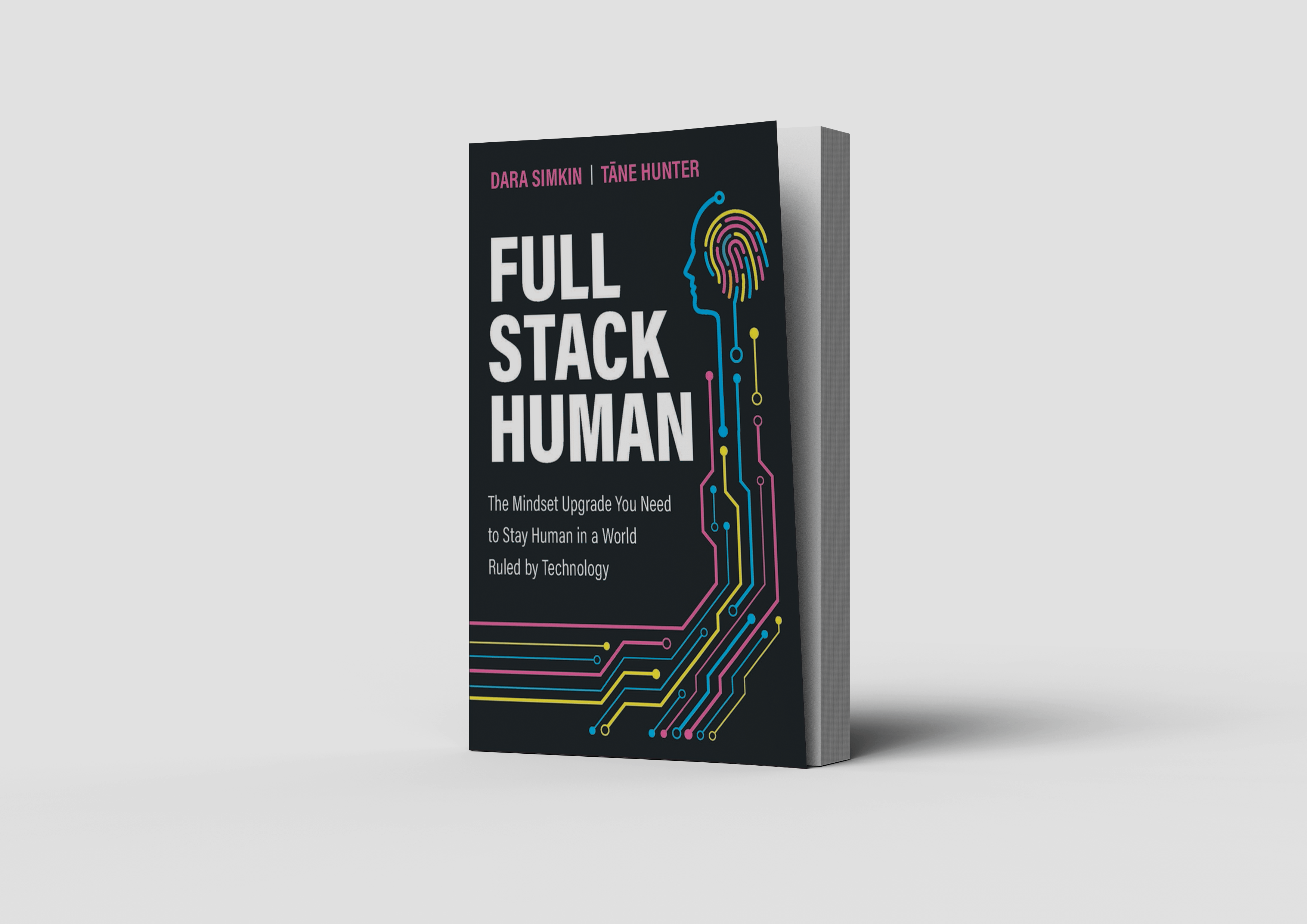
FULL STACK HUMAN BOOK
Chapter 7: Choosing possibilities with intelligent optimism. If you need help finding signal in the noise, and want to find evidence and solutions to overcome our greatest challenges, this is the chapter for you.
Stay human. The world needs it.
— Tāne Hunter
Founder, Future Crunch
Co-author, Full Stack Human
P.S. If you just read this entire piece thinking "yes, other organisations definitely need to hear this," congratulations. You might be a green shoot. Pass this on and seed more.
